
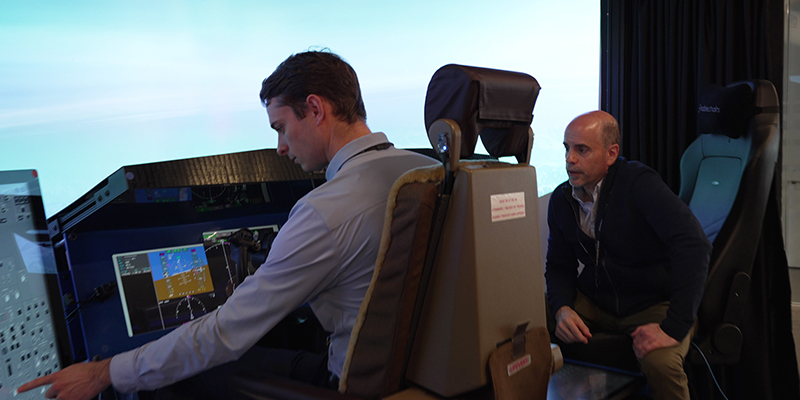
Using a flight simulator, Aurora engineers develop autonomous technologies to assist pilots and optimize safety.
Aurora Flight Sciences, a Boeing company, is working to develop autonomy and advanced automation that can be a better partner for tomorrow’s pilots and aircraft operators. The company’s flight simulation lab, located in Cambridge, MA, is one tool to enable rapid development and testing of future flight technologies.
The flight simulation lab, or ‘flight sim,’ is where the early stages of pilot-assist autonomy are worked through. It’s a flexible, medium-fidelity simulator that can be configured to emulate almost any aircraft, from traditional, piloted airplanes to new, uncrewed aircraft systems. This level of simulator is designed for rapid develop-test cycles to progress technology through early development phases.
Initial testing in the flight sim is conducted by Aurora engineers. As the technology matures, commercial or military pilots are added to get their input. Involving pilots in early development phases allows the team to closely study the relationship between the autonomy and the flight crew and to ensure the new technology is developed to meet pilot needs. After testing in Aurora’s flight sim, technologies then progress to testing in higher fidelity simulators or on real aircraft, including Aurora’s Centaur optionally piloted aircraft.
Most of the autonomy developed and tested in the flight sim lab is designed to support pilots in achieving a higher level of safety, even during unexpected events or high-stress situations. One example uses inputs from a variety of non-invasive sensors like eye trackers and heart rate monitors to estimate a pilot’s workload. Under high workload conditions, autonomy can increase pilot situation awareness, assist with basic functions, or provide decision-making support to help pilots perform at their best.
“Autonomy creates the potential to realize future gains in safety and efficiency beyond what we’ve achieved in the past,” said Bob Vivona, Boeing Technical Fellow and principal autonomy engineer at Aurora. “We have the ability to go after those new levels of benefits and shape where aviation technology is heading. It’s an unbelievable opportunity to achieve that kind of impact.”