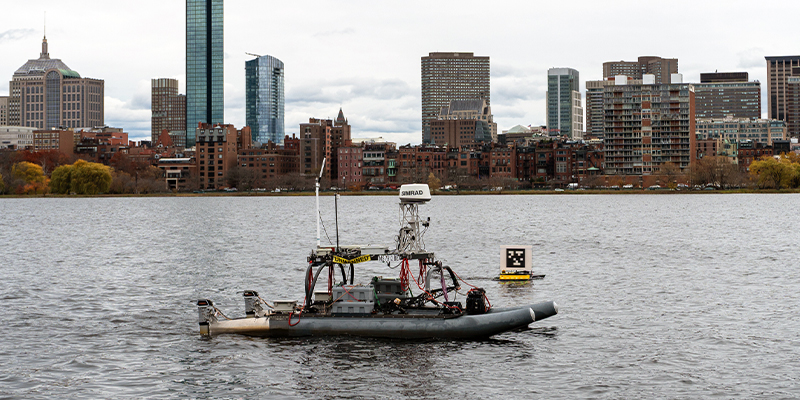
The demo, using uncrewed boats, showed the technology improved safety when operating in challenging conditions.
Aurora Flight Sciences, a Boeing company, demonstrated its ‘Fast Adaptation and Learning for Control Online’ (FALCON) technology, showing the positive impact of the AI-enabled control system on maintaining safe maritime operations. The work is part of the Defense Advanced Research Projects Agency’s (DARPA) Learning Introspective Control (LINC) program.
Aurora, teamed with the Massachusetts Institute of Technology (MIT) Aerospace Controls Laboratory and the MIT Marine Autonomy Laboratory, has been developing a machine learning-based control architecture that enables land, maritime, and aerial vehicles to adapt their control laws in real time. With this technology, called FALCON, vehicles can operate more safely during unforeseen hazards such as component failures or environmental conditions. The learning-based control architecture can be used as an assistant to a human operator or as the primary method of vehicle control.
The demo, held in late 2025, used a 1.5-meter-long, uncrewed surface vessel (USV) paired with a 5-meter-long USV in a relative station-keeping scenario to simulate underway replenishment (UNREP), where two vessels align to allow the transfer of supplies. The goal is to maintain a consistent location relative to another vessel while overcoming hazards such as wind loading, thruster failure, and simulated Venturi effects. Operation is considered to be within the ’safe zone’ when a consistent and safe position is maintained between the two vessels.
The demo compared the performance of two different levels of AI-enabled control technology against a manual control baseline. In AI-assisted mode, the AI quickly compensates for the effect of hazards, helping the human operator to maintain safe operation. In AI-guided mode, the human operator sets desired parameters like speed and position while the AI guides the vehicle in real time.
The team collected data on the percentage of a test run that was operated within the pre-determined ‘safe zone’ and on how long it took the vessel to recover and return to safe operation after an induced hazard.
- Without AI, a human operator piloted the USV within the safe zone 63% of the time. In AI-assist mode, that percentage increased to 82%. In AI-guided mode, operation within the safe zone was 94%.
- When hazards were introduced, the recovery time needed to regain control and return to safe operation was reduced by 61% on average when using AI-guided control compared to manual control.
The team is continuing to refine its algorithms in preparation for its next demonstration event this summer.
DISTRIBUTION STATEMENT A. Approved for public release. Distribution is unlimited.